If you are standing in your backyard thinking it could be so much better, you are not alone. Most Sydney homes have a patch of lawn, a fence line nobody likes, and a bit of dirt that never quite looks right. The good news is that backyard landscaping has moved on a lot. In 2026 the focus is on outdoor rooms, plants that handle Sydney heat and dry spells, and layouts that people actually use. This guide covers the ideas that work well here, what things cost in 2026, whether those prices are fair, and the mistakes we see most often on local jobs.
Ausco Landscaping & Construction is a family-owned team based in Schofields, working across Western Sydney, the Hills District and Greater Sydney. We have seen plenty of backyards go from tired to lovely, and most of the lessons below come from that work.
Why Sydney Backyards Need a Different Plan
Sydney is not one soil type or one climate. A backyard in the Hills District might sit on heavy clay that holds water after a storm. A block near the coast often has sandy soil that drains fast and loses nutrients quickly. Western Sydney gets hotter summers than the eastern suburbs, and many yards get full afternoon sun on the western side.
That means a design that works in Manly may struggle in Penrith. Before you pick plants or materials, take a close look at these things:
- How much sun the yard gets, and at what time of day
- Which way water runs off the roof and across the block
- What the soil feels like (clay feels sticky and holds its shape when wet, sandy soil falls apart in your hand)
- How much time you want to spend on maintenance each week
- Whether the yard needs to handle kids, pets or a pool
Our landscape design and construction team starts with exactly these questions on every site visit, because the answers shape everything that follows.
Backyard Landscaping Ideas That Work in Sydney
Create Separate Outdoor Rooms
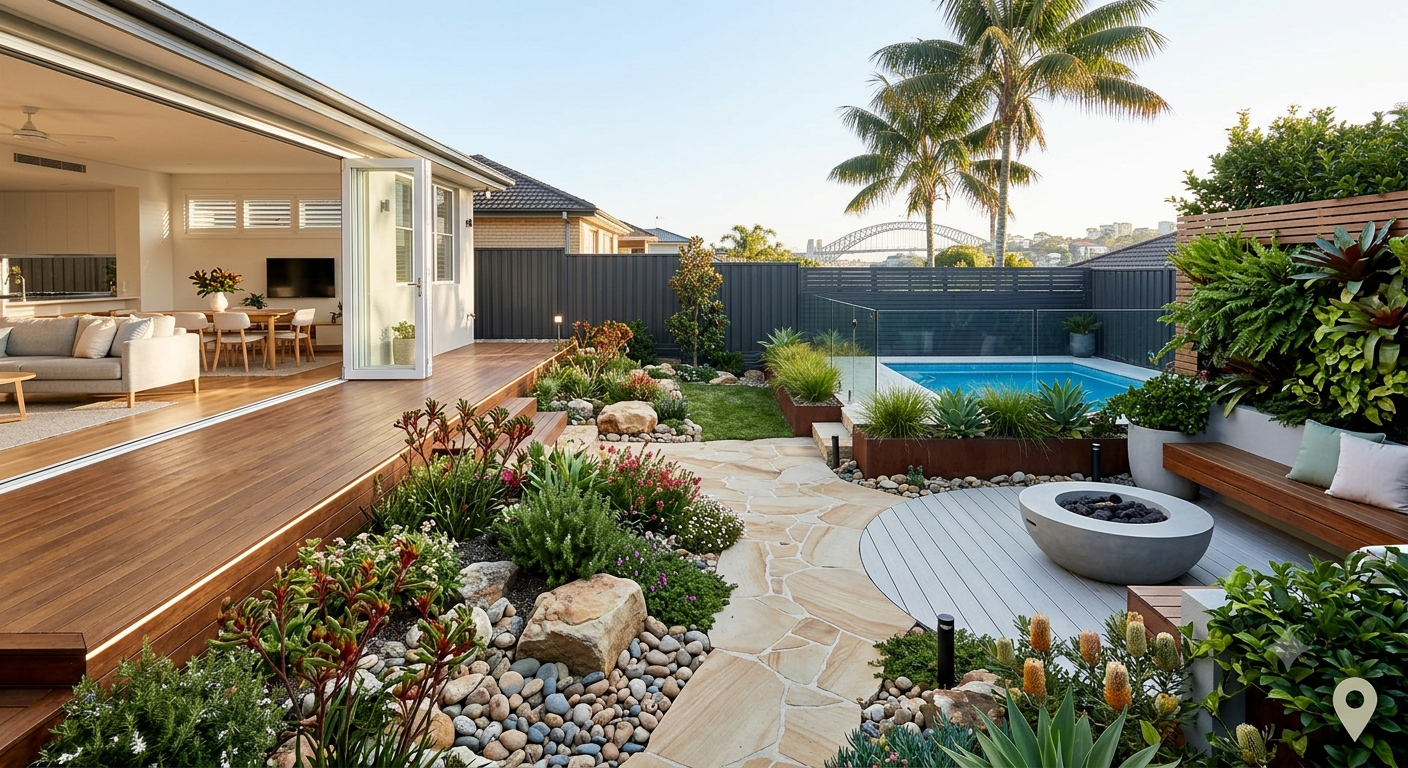
The biggest trend we are seeing is turning one big open lawn into several smaller zones. You might have a dining area near the house, a lawn for the kids or dog, a quiet corner with a bench under a tree, and a path linking them together. This makes the yard feel bigger and gives each part a purpose. Hedges, low garden beds and changes in paving are the easiest ways to split the space without building walls.
Choose Native and Water-Wise Plants
Native plants suit Sydney better than most imported species. They cope with local rainfall patterns, handle heat and attract native birds. Good options for many Sydney gardens include lomandra, westringia, grevilleas, banksias and tussock grasses. Once established, hardy natives usually need far less watering, which keeps your water bill and your weekend workload down.
Do not plant natives in a spot that gets full western sun with no shade at all, though. Even tough plants struggle in that kind of exposure. Read the sun requirements on the label and match them to your yard.
Build an Outdoor Kitchen or Entertaining Zone
Sydney families spend a lot of time outdoors, especially in spring and summer. A paved area with a pergola, a built-in barbecue and some lighting can change how you use the whole yard. Think about where the sun sits in the evening and where smoke will drift when you cook. A corner with afternoon shade is far more comfortable than an exposed slab.
Our hardscaping and structural works service covers outdoor kitchens, pergolas and paved entertaining areas, all built with proper base preparation so they stay level for years.
Replace Some Lawn with Low-Maintenance Surfaces
Lawn looks lovely, but it needs regular mowing, feeding and watering, and it struggles in deep shade. Many homeowners now keep a smaller patch of turf for play and fill the rest with mulched garden beds, pavers, gravel or a mix of these. Ground covers such as native myoporum or dichondra can soften the gaps between stepping stones.
If you are weighing up natural turf against synthetic, our turf installation cost guide for Sydney compares both options over a 10 year period, which is more useful than comparing the price on day one.
Use Timber Decking with a Pergola
Decking adds warmth and gives you a level, usable surface on a sloping block. A pergola on top provides shade and a natural frame for climbing plants like jasmine or star jasmine. Hardwood and treated pine are the most common choices. Composite decking costs more upfront but needs less maintenance, which some owners prefer.
Add Retaining Walls with Planted Beds
If your backyard slopes, retaining walls can turn an awkward hill into flat, usable terraces. They also give you raised garden beds that drain well. Sandstone-look blocks suit many Sydney homes. Taller walls often need council approval and an engineer’s sign-off, so check with your local council before you start. Our team can explain what applies to your block during the planning stage.
Lay Pathways and Stepping Stones
A simple path from the back door to the shed or the back fence makes a yard feel organised. Pavers, stepping stones set into turf and crushed rock paths all work. Keep paths at least 900mm wide if two people need to walk side by side, and choose a surface that is not slippery when wet. If your driveway or side access also needs work, our paving and driveway solutions team handles that too.
Install Lighting for Evening Use
Good lighting extends how long you can use the yard, especially in winter when the sun sets early. Low path lights, uplighting on trees and string lights over the dining area are all popular. LED fittings use very little power and last a long time. Any electrical work should be done by a licensed electrician.
Consider a Rain Garden or Water Feature
A rain garden is a shallow, planted dip that collects runoff from the roof or paved areas and lets it soak into the ground slowly. It helps with drainage problems and can look great with the right plants. A small water feature, like a bowl fountain or a pond with a pump, adds sound and movement. Check that the pump and power points are installed safely before you switch it on.
Landscaping Ideas for a Small Backyard
Small backyards, especially in older suburbs and tight terrace blocks, need careful planning. Every square metre has to work hard. These ideas help small spaces feel larger and more comfortable:
- Use vertical space. Wall planters, trellises with climbers like hardenbergia or passionfruit, and slim trees all draw the eye upward and make the yard feel taller.
- Keep the palette simple. Two or three paving colours and a short plant list look calmer than a mix of everything, and fewer materials also keep costs down.
- Use light tones on fences and walls. Pale surfaces reflect light and make a small yard feel more open.
- Choose one focal point. A single feature tree, a bench or a large planter pulls attention away from how small the space is.
- Pick multi-use furniture. Benches with storage and fold-down tables save room while still giving you seating.
- Plant in layers. Ground covers at the front, shrubs in the middle and a small tree at the back create depth even in a tight space.
- Plan the path first. A clear route from the door to the garden makes the yard feel organised and stops people cutting across your plants.
If you are short on space and not sure where to start, our garden maintenance team can also help keep a small garden looking good once it is finished.
How Much Does Backyard Landscaping Cost in Sydney in 2026?
Cost is the question most people search for first, and it is also the hardest to pin down. Prices depend on the size of the yard, how much of the job is hard landscaping (paving, walls, decking) versus soft landscaping (lawn, plants, mulch), and how easy the site is to access. A tight block with narrow side access will cost more to work on than an open block with a flat driveway.
We checked current 2026 Sydney pricing against several independent cost guides, trade listings and our own published turf pricing before writing this section. All figures are in Australian dollars.
| Item | Typical Sydney Price (2026) | What It Covers |
|---|---|---|
| Basic backyard makeover | $5,750 to $23,000 | Turf, garden beds, basic paving, planting and simple hardscaping |
| Landscaper hourly rate | $63 to $125 per hour | Labour for general landscaping work |
| Natural turf (installed) | $25 to $45 per square metre | Supply, lay and site prep, depending on variety |
| Synthetic turf (installed) | $60 to $140 per square metre | Quality tier decides the price, see our turf guide |
| Concrete or paver paving | $40 to $65 per square metre | Materials only, excludes the base |
| Paving base (concrete) | $1,500 to $3,000 | Depends on area size and ground conditions |
| Retaining wall blocks | $130 to $250 per square metre | Wall face materials, excludes footings and drainage |
| Timber decking | $200 to $1,000 per square metre | Depends on timber type and build complexity |
| Mulch | $60 to $100 per cubic metre | Material only, delivered |
| Timber paling fence | From about $75 per metre | Basic pine or hardwood, materials only |
These are estimates. Cost guides do not always agree, and the same job can vary by thousands of dollars depending on the supplier, access and scope.
Is This Price Good Value?
Here is how we would judge it. The low end of the basic makeover range, around $5,750, is realistic for a small, simple yard with mostly turf and a few garden beds. It is fair for light work, but it usually means base preparation has been kept to a minimum. If a quote sits at the very bottom of the range for a larger yard with pavers or a retaining wall, ask what has been left out. Common gaps are drainage, base compaction, soil improvement and rubbish removal.
The mid-range, roughly $12,000 to $20,000, is where most standard Sydney backyard makeovers land. For a typical block with a mix of lawn and paving, that is reasonable. A 200 square metre backyard split about 60 per cent turf and 40 per cent paving would commonly fall between $15,000 and $25,000.
Decking at $200 to $1,000 per square metre is a wide band, but it makes sense once you know that the cheaper end usually uses basic treated pine and the top end uses hardwood or composite with a custom design. Retaining walls sit in a similar spread for the same reasons.
The short version: the prices are fair for Sydney in 2026, but the quality of the work matters more than the number at the bottom of the quote. Two quotes for the same yard can differ a lot, and the cheapest one is not always the better deal. Ask each landscaper for an itemised quote so you can compare what is included, not just the total.
What Changes the Cost
Several things push a quote up or down:
- Size and shape of the yard, since odd layouts take longer to set out and cut
- Hard versus soft landscaping, because paving and walls cost far more per square metre than turf or mulch
- Access, since carrying materials through a narrow side gate or down steps adds hours of labour
- Soil and drainage, because clay soil or a poor fall may need extra excavation and drainage pipes
- Council approvals, which can add time and fees for taller walls or structures near boundaries
- Materials, with natural stone, hardwood and custom finishes all costing more than basic options
Practical Ways to Save Without Cutting Corners
- Do the work in stages, starting with drainage and the big structures, then adding planting and finishing touches later.
- Keep existing healthy trees and plants where you can.
- Use mulch and ground covers in place of hardscaping in areas people do not walk on.
- Buy native plants in smaller pots. They cost much less and establish well.
- Get at least three quotes, and check that each landscaper holds current insurance and the right licence for the work. Ausco Landscaping & Construction holds Licence No. 481167C.
For a closer look at what a driveway costs in NSW, read our driveway price guide. It is a good example of how to read quotes and spot what is included.
Should You DIY or Hire a Professional?
Some jobs suit a confident weekend DIYer. Planting, mulching, laying a small stepping-stone path and building a simple raised garden bed are all doable with basic tools and some patience. These jobs carry low risk and forgiving results.
Other jobs are better left to professionals. Retaining walls above a safe height, structural decking, drainage that connects to the stormwater system and any electrical work for lighting or pumps should be done by licensed trades. Getting these wrong can cause water damage, structural failure or electrical hazards, and fixing them later often costs more than doing them properly the first time.
Our site preparation and rubbish removal service is also worth considering if the old yard needs clearing before any new work starts. It saves you hiring a separate skip and labour crew.
Common Mistakes to Avoid with Sydney Backyard Landscaping
- Skipping the drainage plan. Water that pools against the house can damage footings and cause dampness inside. Check how water will move before any paving goes down.
- Planting too close to the house or fences. Trees and large shrubs can crack paving, block drains and push against walls as their roots grow. Check the mature size on the label before planting.
- Choosing plants from a photo, not for your yard. A plant that thrives in a shaded, moist garden in the Blue Mountains may die in a hot, exposed Western Sydney backyard.
- Ignoring council rules. Some structures need approval, and building without it can cause problems when you sell.
- Cutting corners on preparation. A nice paver surface laid over a poor base will sink and crack within a few years. The part you cannot see is often the part that matters most.
- Forgetting maintenance. Even low-maintenance gardens need some care, including weeding, pruning and mulch top-ups. Our weed control in spring guide covers the timing that stops weeds getting ahead of you.
Is Landscaping Worth It for Your Home Value?
Many homeowners ask whether a new backyard actually adds value or just adds enjoyment. The honest answer is that a well-planned yard can help a property sell and can make it more attractive to buyers, but it is not a guaranteed return the way some other renovations can be. Our article on whether landscaping really adds value to a Sydney home goes through the numbers in more detail.
Ausco Landscaping & Construction: Sydney’s Trusted Family-Owned Landscapers
When homeowners ask us for a backyard project they can rely on for years, our approach is the same every time. We are a family-owned business, not a volume contractor, so every project gets personal attention. Design and construction sit under one roof, which means one team is responsible for the result from the first site visit to the final finish, with no handover between trades.
We work across Western Sydney, the Hills District and Greater Sydney, and we adapt every plan to local soil, sun and council requirements. You can explore our full range of services on the services page, see finished work in our projects gallery, or read what homeowners say on our reviews page.
Ready to start? Get a free consultation and quote through our contact page or call us on 0451 918 059.
Frequently Asked Questions About Backyard Landscaping in Sydney
How much does a basic backyard makeover cost in Sydney?
A basic makeover in Sydney typically costs between $5,750 and $23,000 in 2026. The final price depends on size, materials, drainage work and how easy the site is to access. For more detail on what is included, see our garden and landscape design service.
How long does a backyard landscaping project take?
A basic makeover usually takes one to two weeks. Larger projects with retaining walls, decking or pool surrounds can take several weeks, depending on weather and any council approvals needed.
What plants grow best in Sydney backyards?
Native plants suit most Sydney gardens well. Lomandra, grevilleas, westringia, native grasses and banksias handle local conditions and need less water once established. Always match the plant to the sun and soil in your yard. Our best time to start a landscaping project in Sydney post explains which seasons suit planting and construction.
What is the best time of year to landscape a backyard in Sydney?
Autumn and early spring are generally the best times to plant in Sydney. The soil is warm enough for roots to establish, and the weather is mild for the first few months. Hard landscaping such as paving and walls can usually happen in most months, as long as the ground is not waterlogged.
Do I need council approval for backyard landscaping?
Many jobs, such as garden beds, turf and paving, do not need approval. Taller retaining walls, some decks and structures close to boundaries often do. Check with your local council before you start, and ask your landscaper what applies to your block.
Is synthetic turf worth it in Sydney?
It depends on how you use the lawn and how long you plan to stay. Budget synthetic products may need replacing within 5 to 7 years in Sydney’s heat, while good quality products can last 10 to 15 years. Our turf installation cost guide walks through the 10 year comparison in full.
How can I make a small backyard feel bigger?
Use vertical planting, keep the colour palette simple, use light tones on fences and walls, and create one clear focal point. Layered planting and multi-use furniture also help a small yard feel open and useful.
Final Thoughts
A good backyard is not about buying the most expensive materials or copying a magazine photo. It is about understanding your yard, choosing a layout that fits how you live, and building it in the right order. Start with drainage and structure, plant for your local conditions, and get itemised quotes so you know exactly what you are paying for. Do that, and you will end up with a backyard you enjoy every day for years.
If you want help planning yours, contact Ausco Landscaping & Construction for a free consultation.