
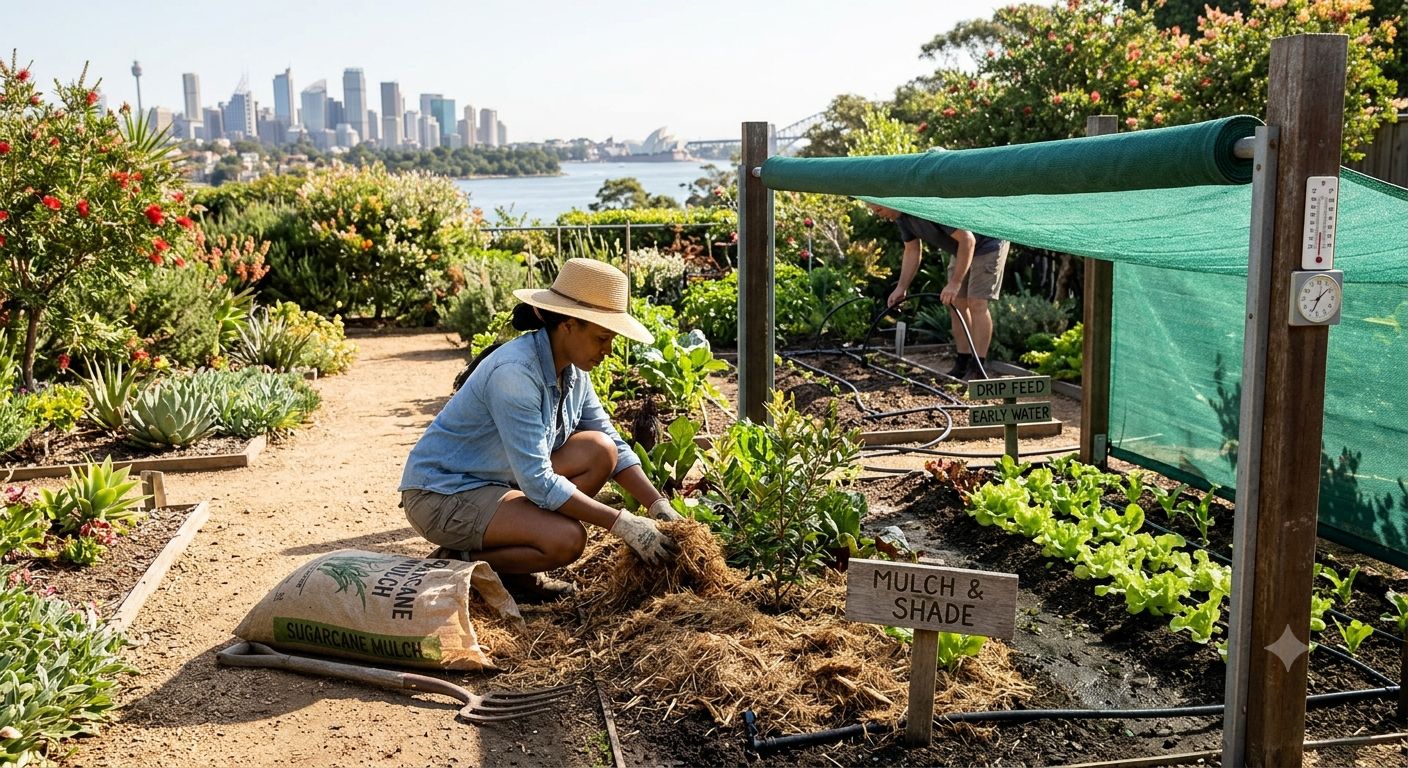
Every year it is the same story. A run of 35 degree plus days hits Sydney in January, and the garden that looked fine at Christmas is suddenly crispy, wilted, and half dead by New Year. The frustrating part is that most of this damage is preventable, it usually comes down to a handful of things that either were not done in time, or were done the wrong way, like watering at midday and wondering why the lawn still went brown.
This guide covers what to actually do before and during a heatwave, what Sydney Water’s watering rules mean in practice, and which of your plants need real attention versus which ones will be fine on their own. We will also cover the mistakes that make heat stress worse, since a few common habits actually work against you.
Get Ahead of It: What to Do Before the Heat Arrives
Mulch everything, properly
This is the single most effective thing you can do and it costs almost nothing compared to the water and plants it saves. A 50 to 75mm layer of organic mulch over garden beds shields the soil from direct sun, cuts evaporation dramatically, and keeps root zones several degrees cooler than bare soil. Keep mulch pulled back a few centimetres from plant stems and tree trunks though, mulch piled right against the base traps moisture against the bark and invites rot and collar rot fungus.
Check your irrigation before you need it, not during
- Run each zone manually and look for blocked or misaligned sprinkler heads
- Check drip lines for splits or blockages, especially if they have not been used since last summer
- Confirm your controller’s start times fall within the legal watering window, more on that below
Deep water a few days out, not the day of
If a heatwave is forecast, give garden beds and lawn a deep, slow soak two to three days before the heat hits, rather than trying to flood everything the morning it arrives. Deep watering pushes roots downward, which is exactly what you want, shallow daily sprinkles just keep roots near the surface where they cook first.
Raise the mower height
Cut your lawn a notch or two higher than usual before a heatwave. Longer grass blades shade the soil and the crown of the plant, which reduces evaporation and heat stress at the root level. Scalping a lawn right before a run of 40 degree days is one of the more common self inflicted mistakes we see.
Sydney Water’s Rules for Garden Watering (And What They Actually Allow)
A lot of homeowners assume Sydney is under some kind of drought level water restriction right now. As of 2026, it is not, dam storage has not dropped low enough to trigger formal restrictions. What is in place year round, restriction or not, is Sydney Water’s Water Wise Guidelines, and these apply every summer regardless of rainfall.
| Rule | What It Means for You |
| Watering window | Only before 10am or after 4pm, every day, year round, this is permanent under Sydney Water’s Water Wise Guidelines, not a drought only rule |
| Approved methods | Trigger nozzle hand hose, sprinkler or watering system, or a smart or drip system, all only within the allowed hours |
| Smart or drip systems | Can run outside the 10am to 4pm window because they use less water overall, worth considering if your garden needs regular deep watering |
| Hard surface hosing | Not permitted except for safety, health, or emergency reasons, so wash down paving with a broom and bucket instead |
| New turf exemption | Unlimited watering for 28 days after laying, following the supplier’s care instructions, apply through Sydney Water before laying if needed |
| Fines | $220 for individuals, $550 for businesses, so it is worth actually knowing the rule rather than guessing |
The technical reason behind the 10am to 4pm rule is worth understanding, because it changes how you should think about watering. Up to 40 percent of water applied in the middle of a Sydney summer day evaporates before it ever reaches the root zone. So watering at midday is not just against the rules, it is also just wasted water and wasted effort, since most of it never gets where you actually need it.
Which Plants Actually Need Extra Attention
Not everything in your garden is equally at risk, and treating every plant the same is a waste of your time during a heatwave.
Higher risk, needs your attention
- Vegetables, herbs, and tender annuals, particularly leafy greens and anything recently planted
- Potted plants, which heat up far faster than plants in the ground since the pot walls absorb heat directly
- Newly planted shrubs and trees still establishing their root systems, generally anything in the ground less than 12 months
- Turf on a slope or in full western sun, which dries out faster than shaded or level lawn areas
Lower risk, generally copes on its own
- Established Australian native plants and Mediterranean species like rosemary, lavender, and thyme, once they have a season or two in the ground
- Mature trees and shrubs with deep, established root systems
- Succulents and other drought adapted plantings
During the Heatwave: What to Actually Do
- Move potted plants into shade, against a cool wall, or under a patio, and keep saucers topped up so roots can draw on that reserve through the day
- Use temporary shade cloth, 30 to 50 percent shade factor, over vulnerable vegetable beds or recently planted specimens, propped on stakes with airflow underneath rather than draped directly on the foliage
- Skip fertilising during extreme heat, feeding pushes new growth right when the plant is already under stress and needs to conserve energy, not produce more leaves
- Hold off on pruning and transplanting until the heat passes, both add stress a plant does not need on top of the heat itself
- Check soil moisture with a finger before watering again, if it is still moist a few centimetres down through the mulch, you do not need to water yet
Common Mistakes That Make Heat Stress Worse
- Watering in the middle of the day, most of it evaporates and what lands on leaves can actually scorch them under direct sun
- Shallow, frequent watering instead of deep, infrequent soaking, this trains roots to stay near the surface where they are most exposed
- Scalping the lawn right before a heatwave, removing the shade the grass provides for its own root zone
- Fertilising during a heatwave, which stresses the plant further at the worst possible time
- Ignoring hydrophobic soil, if water is pooling and running off rather than soaking in, the soil has likely become water repellent and needs a soil wetting product before mulch and watering will actually help
Case Study: Turning Around a Struggling Front Garden Before Peak Summer
A homeowner in Kellyville contacted us in early December after two consecutive summers of losing garden bed plantings to heat stress, despite watering most days. On inspection, the issue was not a lack of watering, it was the opposite problem, frequent shallow watering on a timer had kept roots shallow, and the garden beds had almost no mulch left after a few years of top ups being skipped.
We reset the irrigation to run less often but for longer, so water actually reached deeper into the root zone, added a full 60mm mulch layer across all beds, and swapped a few of the most heat stressed plantings for hardier native species suited to a full western sun position. Going into the following summer, the same beds handled a run of 38 to 40 degree days without any dieback, and the homeowner’s watering time actually dropped since deeper, less frequent watering meant fewer sessions overall.
How Ausco Landscaping & Construction Helps Your Garden Handle Sydney Summers
Preparing a garden for Sydney’s heat is not really about a single fix, it is about the underlying setup, soil, mulch depth, irrigation, and plant selection all working together. Our garden maintenance programs are scheduled around the seasons, so mulch top ups and irrigation checks happen before the heat arrives, not after the damage is already done.
- We assess irrigation coverage and timing as part of routine maintenance, so blocked heads and misaligned zones get caught before a heatwave, not during one
- For gardens that keep struggling every summer despite regular watering, our landscape design team can rework problem areas with more heat tolerant native planting suited to your specific aspect and soil
- We apply mulch at the depth that actually protects soil and roots, not just a thin decorative layer that looks fine but does little in a heatwave
If your garden struggles every summer no matter how much you water it, the underlying issue is usually fixable. Get in touch through our website for a free assessment before the next heatwave hits.
Frequently Asked Questions
What time should I water my garden in Sydney during summer?
Before 10am or after 4pm, this is a permanent, year round rule under Sydney Water’s Water Wise Guidelines, not just a drought measure. Watering in the middle of the day wastes water to evaporation and can scorch leaves.
How much mulch does my garden actually need?
A layer of 50 to 75mm across garden beds gives meaningful protection against evaporation and heat. A thin, decorative sprinkle of mulch looks fine but does very little during an actual heatwave.
Should I water more during a heatwave?
Water deeply a few days before the heat arrives rather than trying to flood everything on the day. During the heatwave itself, check soil moisture before each watering rather than watering on a fixed schedule, since overwatering wastes water without actually helping stressed plants.
Are there water restrictions in Sydney right now?
As of 2026, Greater Sydney is not under formal stage water restrictions, though Sydney Water’s permanent Water Wise Guidelines still apply year round regardless of dam levels. Always check Sydney Water’s current status since this can change with drought conditions.
Want your garden set up to handle summer without the yearly scramble? Get in touch through our website for a free garden assessment before the heat arrives.